Search
× Search

Pollen Seasons

Trees in Central Oklahoma trees begin pollinating from mid-September (mountain cedar from the Arbuckle Mountains) through early May (pecan) and late June (pine). There is a second elm season in the fall (late August to October) due to the introduction of lacebark elms and cedar elms to this area. Each of the common tree species (elm, oak, maple/box elder, pecan/hickory, birch, mulberry, juniper, sycamore, pine, cottonwood/poplar, willow) usually pollinate for only a few weeks but added together the season is quite long.

Grasses

Central Oklahoma has two grass seasons. Cool season grasses (blue, fescue, timothy, rye, orchard, and redtop) can begin as early as late February or March but after a month or two they stop pollinating totally. The warm season grasses (which do not cross-react with cool season grasses) such as Bermuda, Bahia, crabgrass, and Johnson begin when the weather becomes warm and do not always stop until a good hard freeze in November.

Weeds

Some weeds pollinate in late spring or summer (dock and plantain), but most begin in late summer and fall. Ragweed pollination begins based on hours of daylight and almost always begin when the days shorten around the middle of August. However, the weeds often continue to pollinate until there is a hard freeze, often in late November.

Molds

We find molds in Central Oklahoma every day of the year unless there is a very hard freeze and/or the ground is covered with snow.
The Oklahoma Allergy & Asthma Clinic is a certified counting station for pollen and mold. We are associated with the National Allergy Bureau and the AAAAI. You can find our counts on the internet at www.oklahomaallergy.com. We supply the local media (TV stations, newspaper and radio) with our counts every day they are done. To learn more about the National Allergy Bureau (NAB) you can go to www.aaaai.org.

Recent News

SuperUser Account
/ Categories: News

Lone Star Tick Bite – Alpha Gal
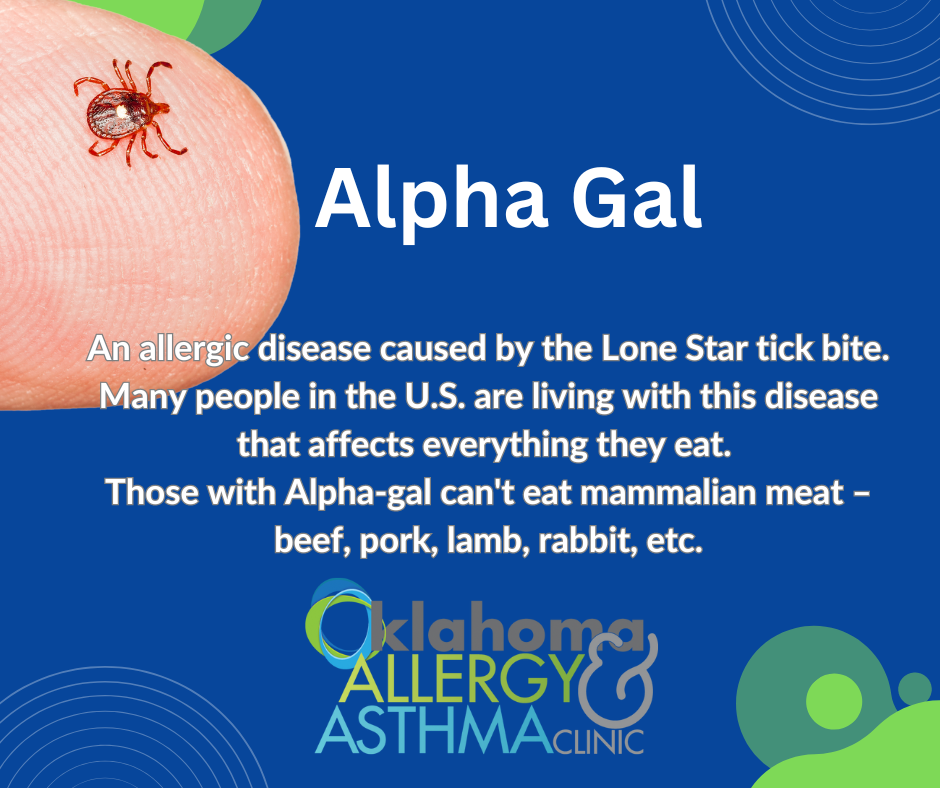
An article in Allergic Living magazine focused on the Alpha-gal allergy – an allergic disease caused by the Lone Star tick bite. However, you may be surprised at how many people are living with this disease that affects everything they eat. Those with Alpha-gal can’t eat mammalian meat – beef, pork, lamb, rabbit, etc. Turns out best-selling author, John Grisham, suffers from this disease, according to the article.

Grisham who keeps meticulous notes, found out in 2012, after working with his allergist on his case of his skin feeling like it was on fire. His hives were actually a reaction to eating mammalian meat.

According to the article, Grisham has become an old pro at managing his meat-restricted diet with the help of his wife, Renee, who also has the disease. He has learned to savor healthy alternatives to beef and pork although he regularly gets red meat cravings.

He and Renee live near Charlottesville, Virginia, while beautiful and historic, is a favorite habitat to the Lone Star tick.

There is no treatment for red meat allergy beyond avoiding the consumption of red meat and in some cases, dairy and gelatin. There is a chance this allergy may resolve over time if the affected person prevents getting another tick bite. As research advances, there is hope a better treatment of red meat allergy will be found.

“With our mild winter, ticks are out, and ready to bite,” says OAAC Board-Certified Allergist Dr. Laura Chong. “Warmer weather means we are starting to spend more time outside. Be sure and take your tick prevention precautions for you and your pets that carry them inside your house.”


The post Lone Star Tick Bite – Alpha Gal appeared first on Oklahoma Allergy and Asthma Clinic.

Previous Article Stinging Insect Allergy Can Ruin Outdoor Activities
Next Article Grass Pollen Allergy
Print
19
Terms Of UsePrivacy StatementCopyright 2026 by Oklahoma Allergy and Asthma Clinic
Back To Top