Needle-Free Option for Severe Allergic Reactions Expanded for Use in Children
Doctors at the Oklahoma Allergy and Asthma Clinic call the FDA approval a game-changer
Parents now have a needle-free, life-saving option should their child experience a severe allergic reaction.
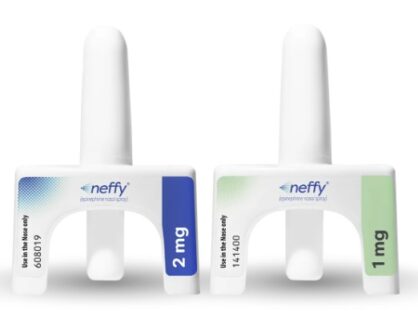
The U.S. Food and Drug Administration this week approved neffy nasal spray in a one milligram dose, expanding its use to younger children. Neffy is a nasal spray for the emergency treatment of severe allergic reactions, including anaphylaxis. The FDA action means neffy may now be used in children ages four years or older, weighing between 33 and 66 pounds.
The drug was originally approved as a two-milligram dose for individuals over 66 pounds back in August of 2024.
“The approval of one milligram neffy is a game-changer for our young patients who suffer from severe allergies and asthma-related anaphylaxis,” said Dr. Maya Gharfeh, allergy and asthma specialist at the Oklahoma Allergy & Asthma Clinic. “As a physician, I’ve seen firsthand the hesitation and fear that children and parents experience when faced with the need for an epinephrine injection. With neffy, we now have a needle-free alternative that can provide the same life-saving benefits in a less intimidating way.”
Neffy provides a convenient and effective solution for managing life-threatening allergic reactions without the need for injections.
“Anaphylaxis is life-threatening, and some people, particularly children, may delay or avoid treatment due to fear of injections,” said Dr. Kelly Stone, Associate Director of the Division of Pulmonology, Allergy, and Critical Care at the FDA’s Center for Drug Evaluation and Research. “The availability of epinephrine nasal spray may reduce barriers to rapid treatment of anaphylaxis.”
According to the the Asthma and Allergy Foundation of America, anaphylaxis occurs in about one in 50 Americans and some estimates place it as high as one in 20.
“As allergy specialists, we know that some parents of small children may hesitate to use traditional epinephrine auto-injectors due to needle anxiety. Now, we have another option for them,” Gharfeh added.
Neffy is expected to be available in the United States by the end of May 2025.
For more information about the Oklahoma Allergy & Asthma Clinic, visit at www.oklahomaallergy.com or for an appointment, call 405-235-0040.
The post Needle-Free Option for Severe Allergic Reactions Expanded for Use in Children appeared first on Oklahoma Allergy and Asthma Clinic.
60