Search
× Search

Environmental Control for Indoor Allergens

Environmental Control for Indoor Allergens

House dust contains a variety of allergens such as insect parts, animal dander, and dust mites. Furthermore, mold may also be present in homes. It is important to eliminate as much allergen as possible from the home in order to derive maximum benefit from your treatment.

House Dust Mite is probably the most important allergen in most homes. Controlling house dust mite exposure will decrease symptoms in allergic patients and may decrease the risk of developing dust mite allergy in patients not yet sensitized. Dust mites are tiny microscopic creatures that thrive in warm, moist climates. Upholstery (particularly the bed) is the ideal habitat for dust mites because they need the protection of the padding and a food supply (shed human skin) to survive. They cannot thrive on non-porous surfaces or in cool dry climates.

There are simple things you can do to minimize dust mite exposure:

  • You should concentrate on the bedroom (particularly the bed) because this is where you spend most of your time. In fact, when you are sleeping, you are breathing with your mouth and nose inches from a whole army of dust mites. The bedroom should be clutter free.
  • Dusting should be done frequently with a damp cloth.
  • The humidity in the bedroom should be kept below 50%. In Central Oklahoma this generally requires only air condition, but may require a de-humidifier. Humidifiers encourage dust mite and mold growth and should be avoided.
  • The mattress, box spring and pillow should be encased in dust mite proof encasements. All items on the bed should be washed in hot water (140 degrees) every one to two weeks. Stuffed animals should be removed from the bed.
  • Upholstered furniture and wall to wall carpet contain dust mites and should be avoided if possible, but these are not nearly as important as the bed.
  • Air filters, expensive vacuum cleaners, and duct cleaning help only minimally. When vacuuming, a HEPA filter or double bag should be used to minimize dust mites being stirred up and released into the air.

Cockroaches are now recognized as important indoor allergens. Other insects such as lady bugs, spiders, and crickets have recently been implicated. Keep the home clean and dry and fix any leaks or drips. It may be necessary to have an exterminator treat the home periodically.

Animal dander, generally from cats and dogs (but sometimes from gerbils, hamster, guinea pigs, mice, etc.) is a very important source of allergen in dust. Contrary to popular belief, animal hair is not the problem. Rather, it is a protein in the urine, saliva and dander of animal that provokes allergy. There are no “nonallergenic” furred pets. Some individual animals produce more allergen than others but there are no “safe” breeds.

  • The best thing you can do if you are allergic is to eliminate the pet.
  • Keeping the animal outside is only a partial solution because people who handle the animals outside will bring the allergen in on their clothes.
  • If you cannot eliminate the pet, try to keep the pet in non-upholstered areas and never let the pet in the bedroom. A HEPA filter in the bedroom may provide some protection.
  • Bathing the animals weekly may decrease the amount of allergen they produce.
  • After the animal has been removed, it can take as long as a year for allergen levels in the home to drop significantly, so a good thorough cleaning of the home is necessary after eliminating the animal.

Recently some information has come to light which suggests that if you are not already allergic it may actually be helpful to have cats or dogs in the home. However, if you are already pet allergic having the pets around will only worsen your allergic symptoms.

Indoor Mold can also cause significant allergic respiratory symptoms. Homes with high humidity and/or leaks have a high likelihood of having significant indoor molds. Once these issues have been fixed, it is generally easy to eliminate molds, but if you continue to have problems with water leaks or high humidity, you will have a hard time cleaning up your mold. Use a cleaning solution containing 5% bleach and a small amount of detergent to clean up moldy areas. Performing house dust control measures will help as well.

Recent News

SuperUser Account
/ Categories: News

Important Recall Notice for AIRSUPRA Inhalation Aerosol
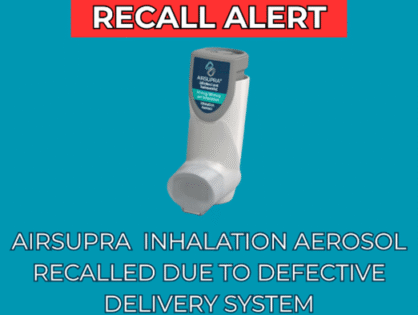
AstraZeneca Pharmaceuticals LP, the maker of the inhalation medication AIRSUPRA® (albuterol and budesonide) aerosol, has initiated a voluntary recall for their product. This recall is effective immediately and involves multiple product lots. The recalled inhalers might not work properly.

Reason for Recall:

A defect in the delivery system of these inhalers has been identified, which may hinder the proper administration of the medication needed for effective asthma control.

Product Details:

Product Name: AIRSUPRA (albuterol and budesonide) inhalation aerosol 

Strength: 90 mcg/80 mcg per inhalation 

Packaging Types:

120-inhalation canister (NDC 0310-9080-12) 

 28-inhalation canister (NDC 0310-9080-28) 

Recall Number:  D-0444-2025 

Affected Lot Numbers:

For 120-inhalation canisters: Lots: 6270044C00, 6270040D00, 6270034E00, Exp Date 10/2026; 6270053C00, 6270045C00, 6270047C00, 6270056C00, 6270052C00, 6270063E00 Exp 11/30/2026; 6270064C00, 6270071D00, 6270075D00, 6270075F00 Exp Date 12/31/2026; 6270107C00, Exp Date 9/30/2027  

For 28-inhalation canisters: Lot 6270019E00, Exp Date 7/31/2025; 6270021D00, Exp 8/31/2025; 6270095C00, Exp 2/28/2026

Rx only, Manufactured for: AstraZeneca Pharmaceuticals LP, Wilmington, DE 19850, By: AstraZeneca Dunkerque Production (AZDP), Dunkerque, France, Product of France

What You Should Do:

Patients and users are advised not to use the inhalers associated with the affected lots. Please contact your pharmacy or healthcare provider as soon as possible to discuss alternative treatment options. Contact the dispensing pharmacy or AstraZeneca for return processing information.

If you are a current patient of the Oklahoma Allergy and Asthma Clinic affected by this recall, please give us a call at 405-235-0040.  

Recall Contact Information:

For product questions, to report an adverse event or side effect, or to report a product quality issue, you can contact the AstraZeneca Information Center by phone at:

1-800-236-9933 (M-F, 8AM-6PM ET, excluding holidays)

Or you can report a product quality issue online: https://contactazmedical.astrazeneca.com/content/astrazeneca-champion/global/en/amp-form.html

For more information on this recall, please visit: https://www.accessdata.fda.gov/scripts/ires/?Event=96857

The post Important Recall Notice for AIRSUPRA Inhalation Aerosol appeared first on Oklahoma Allergy and Asthma Clinic.

Previous Article Needle-Free Option for Severe Allergic Reactions Expanded for Use in Children
Next Article Main Clinic Update
Print
61
Terms Of UsePrivacy StatementCopyright 2026 by Oklahoma Allergy and Asthma Clinic
Back To Top