Search
× Search

Asthma at School

Role of the Teacher

Identify the high-risk students with asthma:

  • Previous life-threatening episodes
  • Three or more emergency room visits in one year
  • Prior hospitalizations within one year
  • History of non-adherence to asthma treatment regimen
  • Recurrent nighttime asthma requiring medications
  • Know the early warning signs
  • Have a copy of the students Asthma Action Plan in your classroom
  • Understand the student may feel tired, different from other students, anxious
    about easy access to medications, embarrassed about asthma, worried about
    activities that induce asthma

Asthma Facts

  • Asthma is the most common chronic disease of children
  • There are approximately 22 million people in the USA diagnosed with asthma
  • Asthma is the leading cause of school absenteeism in the United States
  • Children with uncontrolled asthma miss approximately 14 days of school per year
  • Asthma education is a vital component of asthma management
  • Asthma specialists (Allergist, Pulmonologist) are needed to care for mild
    persistent, moderate persistent and severe persistent asthma
  • If properly managed, people with asthma can live a happy, healthy, active life

Early Warning Signs

  • Low peak flows
  • Chronic cough (especially at night)
  • itchy, scratchy, sore throat
  • headache, stopped up head, sneezing
  • shortness of breath with exertion restlessness, more irritable,
    or at even rest
  • dark circles under the eyes
  • restlessness, more irritable
  • increased fatigue
  • tired, itchy watery, glassy eyes

Asthma Action Plan

An action plan is a treatment plan for worsening asthma. The action plan adjusts to the severity of symptoms so that students can control their asthma. People with asthma should have a treatment and management plan developed by their health care team. An Asthma Action Plan is a special road map to know how to take care of asthma each day.

When peak flow rates are:

Green Zone
  • Everything is all "go"
  • 80% or more of what your peak flow rate should be
Yellow Zone
  • Caution
  • 60 to 80% of what your peak flow rate should be
Red Zone
  • Medical emergency - peak flow rates are less than 50% of what it should be

Peak Flow Monitoring

A peak flow meter is a device that measures how well air moves in and out of the lungs. During an asthma episode, the airways become inflamed and narrowed. Many people who take asthma medicine daily use a peak flow meter several times a day.

How to Use the Peak Flow Meter

  • Set the marker to the bottom of the numeric scale.
  • Take a deep breath. Be sure you are standing up.
  • Place your lips tight around the mouthpiece.
  • Talk a big deep breath in.
  • Blow as hard and fast as possible. Blast the air out fast!
  • Note the final position of the marker. This is your peak flow rate.

Inhalers

Metered dose inhaler:

This is a small canister that contains the medication you need to control your asthma or relieve bronchospasms during an asthma episode (Advair HFA, Symbicort, ProAir HFA, Xopenex HFA, Albuterol HFA, Flovent HFA, Q-Var HFA, etc.). Proper inhaler technique must be performed to efficiently receive the medicine.

  1. Shake inhaler and place in your spacer. You may need to remove the inhaler from the canister if your spacer requires no case.
  2. Take 2 or 3 slow and deep warm up breaths.
  3. Sit up straight and be sure you are holding your head looking straight ahead.
  4. Slowly exhale.
  5. Place inhaler in your mouth, and then spray one spray.
  6. Slowly breathe in and hold your breath at least 10 seconds.
  7. Remove the spacer from your mouth and slowly exhale.
  8. Properly place spacer back into your mouth and slowly breathe in again.
  9. Hold your breath at least 10 seconds then slowly exhale.
  10. Wait 1 to 3 minutes and repeat as ordered by your doctor. (Be sure to shake your inhaler again!) Rinse your mouth after using anti-inflammatory medications.

Dry powdered inhalers:

This is medication that is in powder form. (Advair Diskus, Pulmicort Flexhaler, Asmanex, etc.)

  1. Breathe out slowly.
  2. Put your mouth on the mouthpiece.
  3. Take a big deep breath in real fast.
  4. Hold your breath for 10 seconds.
  5. Blow out slowly.

Recent News

SuperUser Account
/ Categories: News

Needle-Free Option for Severe Allergic Reactions Expanded for Use in Children
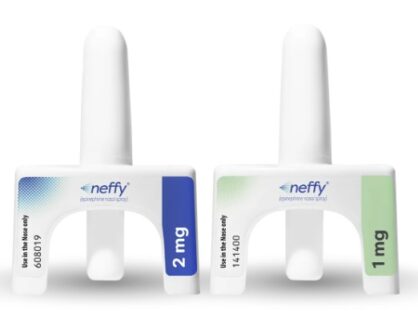
Doctors at the Oklahoma Allergy and Asthma Clinic call the FDA approval a game-changer

Parents now have a needle-free, life-saving option should their child experience a severe allergic reaction.

The U.S. Food and Drug Administration this week approved neffy nasal spray in a one milligram dose, expanding its use to younger children. Neffy is a nasal spray for the emergency treatment of severe allergic reactions, including anaphylaxis. The FDA action means neffy may now be used in children ages four years or older, weighing between 33 and 66 pounds.

The drug was originally approved as a two-milligram dose for individuals over 66 pounds back in August of 2024.

“The approval of one milligram neffy is a game-changer for our young patients who suffer from severe allergies and asthma-related anaphylaxis,” said Dr. Maya Gharfeh, allergy and asthma specialist at the Oklahoma Allergy & Asthma Clinic. “As a physician, I’ve seen firsthand the hesitation and fear that children and parents experience when faced with the need for an epinephrine injection. With neffy, we now have a needle-free alternative that can provide the same life-saving benefits in a less intimidating way.”

Neffy provides a convenient and effective solution for managing life-threatening allergic reactions without the need for injections.

“Anaphylaxis is life-threatening, and some people, particularly children, may delay or avoid treatment due to fear of injections,” said Dr. Kelly Stone, Associate Director of the Division of Pulmonology, Allergy, and Critical Care at the FDA’s Center for Drug Evaluation and Research. “The availability of epinephrine nasal spray may reduce barriers to rapid treatment of anaphylaxis.”

According to the the Asthma and Allergy Foundation of America, anaphylaxis occurs in about one in 50 Americans and some estimates place it as high as one in 20.

“As allergy specialists, we know that some parents of small children may hesitate to use traditional epinephrine auto-injectors due to needle anxiety. Now, we have another option for them,” Gharfeh added.

Neffy is expected to be available in the United States by the end of May 2025.

For more information about the Oklahoma Allergy & Asthma Clinic, visit at www.oklahomaallergy.com or for an appointment, call 405-235-0040.

The post Needle-Free Option for Severe Allergic Reactions Expanded for Use in Children appeared first on Oklahoma Allergy and Asthma Clinic.

Previous Article Not a Cold. Not the Flu. It’s Cedar Fever! Who Knew?
Next Article Important Recall Notice for AIRSUPRA Inhalation Aerosol
Print
26
Terms Of UsePrivacy StatementCopyright 2026 by Oklahoma Allergy and Asthma Clinic
Back To Top