Search
× Search

Asthma: Take Control - Don’t Let Asthma Control You!

Asthma: Take Control- Don't Let Asthma Control You!

A diagram of the human respiratory system

When you breathe, air travels through tubes (bronchi , bronchioles) in your lungs
to reach tiny air sacs (alveoli) so that your body can get the oxygen it needs.

What Causes Asthma?

Asthma is a chronic condition in which the lining of the airways, or bronchial tubes, is inflamed and overly sensitive to many factors which "irritate" them. Exposure to one of these irritating factors can cause symptoms in a person with asthma.

What Are "Asthma Triggers"?

Factors which irritate the airways and cause asthma symptoms arc called "asthma triggers." Many substances or events can trigger chest tightness, coughing, and wheezing. Some triggers are common for many people including:

  • Respiratory infections
  • Exercise
  • Cold Air
  • Cigarette smoke
  • Odors, perfumes, aerosols
  • Air pollution
  • Allergens
  • Emotional stress
  • Fatigue
  • Weather changes
  • Gastroesophagcal Reflux Discasc/LPR

What are Early Warning Signs?

Many patients notice a variety of symptoms that occur before the onset of chest symptoms. Examples include:

  • Fatigue
  • Irritability
  • Itching of chin or back
  • Dark circles under the eyes
  • A drop in your peak flow values

It is important to identify and recognize these early warning signs and to intervene before asthma symptoms progress.

How Do My Asthma Medications Help?

Medications used to treat asthma can be grouped into two broad categories based on how they work to relieve or prevent asthma symptoms.

Quick -Relief (Rescue) Medications: Bronchodilators

Rescue medications open the airways by relaxing the muscles surrounding the bronchial tubes.

  • Beta-agonists: inhaled short acting beta-agonists include albuterol (Proventil HFA, Ventolin HFA, ProAir), pirbuterol (Maxair), levalbuterol (Xopenex HFA) and alupent. These are taken "as needed" for quick relief of asthma symptoms and may be used before exercise to prevent exercise induced symptoms.
  • Anticholinergics ( e.g., Atrovent=ipratropium bromide): Used to open the airways and are many times used with beta agonist to improve bronchodilation. May also be helpful when cough is prominent symptom.

Long-term, Controller Medications:

Anti-inflammatory Drugs: control inflammation of the bronchial tubes. Prevent asthma symptoms by reducing the ever- present inflammation of the airway lining. They take time to work, and must be used on a regular basis. There are three families of anti inflammatory drugs.

  • Steroids: Inhaled steroids are "cortisone like" steroids which work locally in the lungs to decrease inflammation. (e.g., Asmanex, Azmacort, Vanceril, QVAR, Aerobid, Flovent, Pulmicort). Systemic steroids (e.g. prednisone, Medrol) are strong inflammatory drugs most often used in short courses (about 3-7 days).
  • Leukotriene blockers: Medications which block the receptors for leukotrienes (Accolate, Singulair) or block the synthesis of leukotriense (Zyflo ). Leukotrienes are cellular mediators which lead to bronchial inflammation and narrowing, and cause an increase in mucus production in the bronchial tubes.
  • Combination Inhaled steroid/ Long-acting Bronchodilator (e.g. Advair Diskus, Advair HF A, Symbicort)
  • Cromolyn (Intal) and nedocromil (Tilade)

Bronchodialators:

  • Long-acting bronchodilators ( e.g. Serevent, Foradil) Should not be used as "rescue" medication or alone as controller.
  • Theophylline (e.g. , Theo-24, Uniphyl ): oral bronchodilator to be taken on a regular, longterm basis.

Potential Side effects

  • Bronchodilators: increased heart rate, jitteriness
  • Inhaled steroids: thrush, hoarseness
  • Long-acting bronchodilators: potential increased risk of rare, serious life threatening asthma attacks
  • Oral steroids (short term use) increased appetite, weight gain, water retention, moodiness, irritability, insomnia, stomach upset
  • Oral steroids (long term use), growth suppression, cataracts, glaucoma, osteopenia/osteoporosis

What Happens During An Asthma
Flare-Up?

Asthma symptoms occur when there is blockage of the bronchial tubes, causing a whistling noise called "wheezing", cough, shortness of breath, and/or chest tightness. This blockage is caused by three things:

  • Swelling or "edema": the lining of the bronchial tubes swells, expanding inward, making the size of the airway smaller. This swelling is caused by increased inflammation of the bronchial tube lining.
  • Mucus secretion: the tissues that line the bronchial tubes secrete extra mucus which can plug the narrowed air passages even further.
  • Bronchospasm: the muscles that surround the bronchial tubes tighten and make the airway even smaller.

Together, the swelling, mucus, and bronchospasm in the airways make it harder to move air through the bronchial tubes. The person with asthma must work harder and breathe faster to move air through these narrowed airways.

How Can I Prevent Asthma Symptoms From Becoming More Severe?

  • A void the asthma triggers that may be causing the symptoms.
  • Learn to recognize early warning signs
  • Stop what you are doing, rest, and take slow deep breaths.
  • Sip warm fluids to help relax
  • Take two puffs of your bronchodilator inhaler to help relieve your symptoms
  • Follow your asthma management plan

When Do I Call the Doctor's Office?

Sometimes asthma episodes become more severe despite your best efforts to treat them early. A change or increase in medications or further medical treatment may be needed. Call your doctor's office or seek medical help if:

  • Asthma symptoms continue or worsen despite all treatment steps that your physician has given you
  • The medicines are not helping or not lasting as long as they should.
  • You have any doubt about the severity of an attack

Recent News

SuperUser Account
/ Categories: News

OKC named 4th most challenging city for spring allergies

3-15-2023 – Today, the Asthma and Allergy Foundation of America (AAFA) released its annual Allergy Capitals™ report for 2023. The report identifies the most challenging cities for pollen allergies in the 100 most populated metropolitan areas in the continental United States. Cities are ranked based on tree, grass, and weed pollen scores, over-the-counter allergy medicine use, and availability of board-certified allergists/immunologists.

Oklahoma City was ranked fourth and Tulsa was fifth. Wichita, Kansas, took the top spot based on its high tree and grass pollen scores, higher-than-average use of allergy medicines, and limited number of allergy/immunology specialists per patient.

The top 20 Allergy Capitals for 2023 are 1. Wichita, KS; 2. Dallas, TX; 3. Scranton, PA; 4. Oklahoma City, OK; 5. Tulsa, OK; 6. Sarasota, FL; 7. Cape Coral, FL; 8. Orlando, FL; 9. Des Moines, IA and 10. Greenville, SC.  Oklahoma was sixth in 2022 while Tulsa was 21st.

AAFA began identifying annual Allergy Capitals 20 years ago in 2003. Since that first report, pollen counts have worsened. This year’s report once again highlights the significant impact that climate change has on public health – specifically, for people with pollen allergies. Rising temperatures result in longer growing seasons, leading to higher pollen concentrations in many areas of the country.

“We are experiencing longer and more intense allergy seasons because of climate change. For people with asthma, allergies can trigger an asthma attack,” says Kenneth Mendez, CEO and president of AAFA. “About 81 million people in the U.S. have seasonal allergic rhinitis, which is most often caused by pollen allergies. If we don’t take immediate action on the climate crisis, pollen production will only intensify. This means more allergy and asthma attacks and additional strain on our health systems.”

The National Climate Assessment from the U.S. Global Change Research Program confirms that climate change is a major threat to public health. Longer and more intense pollen seasons caused by climate change particularly impact people with allergies and asthma. From 1990-2018, the plant-growing season extended an average of 20 days and produces about 21 percent more pollen, putting people with pollen allergies at risk of more symptoms for longer periods. Allergies can also trigger asthma episodes or attacks. Around 60-80 percent of the nearly 26 million people in the U.S. with asthma have allergic asthma.

“As pollen counts spike, we often see spikes in emergency room visits for asthma,” Mendez says. “Around 3,600 people per year die from asthma, so it is important to address and manage asthma and allergy triggers where you live.”

Black, Hispanic, and Indigenous populations bear the disproportionate burden of air pollution, asthma, allergies, and climate change. This is the result of a long history of discriminatory housing and environmental policies in the U.S. that have pushed people of color to live in undesirable neighborhoods with greater environmental and social risks. As a result of systemic racism in U.S. policies, governance, and culture, racial and ethnic minority populations are more vulnerable to the health impacts of climate change.

“AAFA’s Allergy Capitals™ report serves as a national call-to-action on climate change due to its impacts on individual and community health,” says Melanie Carver, chief mission officer of AAFA. “While there are steps individuals can take to manage their symptoms, it is imperative for communities to build their climate resiliency, improve their city planning, and take action on health disparities impacting higher risk populations.”

For people who are impacted by pollen allergies, there are options available to prevent or treat allergy symptoms. Treatment options include over-the-counter or prescription allergy medicines. Medications are most effective when started before a person’s allergy season begins.

“The Oklahoma City area has pollen all four seasons of the year, so many allergy sufferers don’t get much of a break,” said Bret Haymore, MD, board-certified allergist with the Oklahoma Allergy & Asthma Clinic.

Haymore recommends seeing an allergist who can find out what your allergy triggers are and make a treatment plan to best help manage them.

For more information, visit the OAAC website at www.oklahomaallergy.com to view the addresses for all Oklahoma Allergy and Asthma Clinic locations.  To make an initial appointment or to request more information, please call (405) 235-0040.
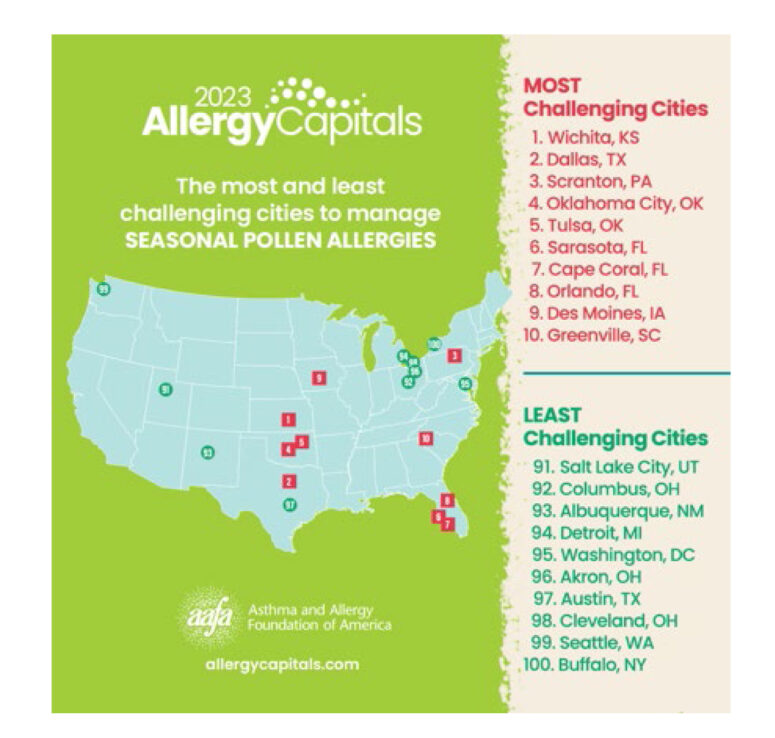
Spring Allergy Chart


The post OKC named 4th most challenging city for spring allergies appeared first on Oklahoma Allergy and Asthma Clinic.

Previous Article Dr. Claire Atkinson passes allergy and immunology board exam
Next Article OAAC does not Renew Lease for Midwest City Satellite Clinic
Print
23
Terms Of UsePrivacy StatementCopyright 2026 by Oklahoma Allergy and Asthma Clinic
Back To Top