Search
× Search

Allergy Injection Treatment Procedures and Precautions

Allergy Injection Treatment Procedures and Precautions

Method of Administration

Allergy injections are given subcutaneously, half-way between the elbow and the shoulder along the outer aspect of the back of the upper arm, or the outside of the mid-thigh. They should not be given too shallowly in the skin, nor should they ever be given without first aspirating (drawing back on the syringe plunger after the needle is in the tissue). If blood is seen when aspirating, the needle should be withdrawn before injecting and another area should be used for the injection. If there are 2 vials (such as “LEFT” and “RIGHT”), there should be 2 injections each time shots are given unless the doctor instructs otherwise. Some injections will be given from individual numbered unit dose vials while other will be dispensed from a larger multi-dose vial according to instructions specific for an individual patient.

A disposable 1 cc allergy treatment syringe with the ½ or 5/8 inch, 25, 26 or 27 gauge, regular bevel needle should be used to give the injections.

Important Precautions

  • The injections should never be administered unless injectable epinephrine 1:1000 is immediately available and there is a reliable person other than the patient to inject it.
  • OAAC requires that allergy injections be administered by a medically competent person in a medical facility equipped to treat (possible severe) allergic reactions. This advice encompasses all patients – even doctors, nurses, and other health professionals who are allergy patients.
  • Administration of allergy shots outside of an OAAC shot treatment room (for example your physician’s office) must be cleared by your OAAC physician (not just from your primary care physician or other health care provider); please do not proceed without it.

Injection Reactions

Allergy injection treatment is intended to decrease a patient’s sensitivities so that in time he/she will feel better. Injections should not cause allergy symptoms. Whenever problems occur, please discuss it with your OAAC doctor or staff.

A local reaction to an allergy injection consists of redness, soreness, itching, and/or swelling at the injection site. Most allergic individuals can be expected to have some local reaction at times. Some will have moderate local reactions regularly, at least until they have been on treatment for many months.

Should there be an excessive (greater than a quarter or 25 cent piece in diameter and lasting more than 24 hours) local reaction after an injection, an antihistamine (like Benadryl, Claritin, Allegra, Zyrtec or Xyzal), cold compress, and topical steroid cream may be used for symptom relief. Your OAAC physician and staff must be notified of the dose number and of the name of the specific vial before more injections are given. A dosage reduction may be indicated.

Systemic (generalized) anaphylaxis reactions to allergy injections are rare (0.015 to 0.02% of injections administered at OAAC Clinics). However, if they occur, prompt treatment with Epinephrine and not just an antihistamine like Benadryl is vitally important. It could save your life. In the event of a systemic (generalized) reaction after an allergy injection, there may or may not be marked swelling at the injection site, plus a vague feeling of apprehension and itching of the palms followed by generalized hives, flushing, sneezing, nasal congestion, increased mucus production or throat clearing, difficulty breathing, coughing, or wheezing.

PATIENTS MUST WAIT 20-30 MINUTES AFTER AN INJECTION SO THAT THEY MAY BE OBSERVED FOR SIGNS OF A GENERALIZED REACTION.

This type of reaction requires treatment with Epinephrine and not just an antihistamine like Benadryl. Prompt medical attention is always needed. If the shot was given at a location other than an OAAC treatment room your clinic physician must be notified before further allergy injections are given because dosage reduction is mandatory. Your OAAC physician is always notified by staff of systemic reactions which occur at an OAAC treatment room.

Beta blocker drugs may make systemic reactions more difficult to treat and you must notify your OAAC physician if you are taking one.

Recent News

SuperUser Account
/ Categories: News

Important Recall Notice for AIRSUPRA Inhalation Aerosol
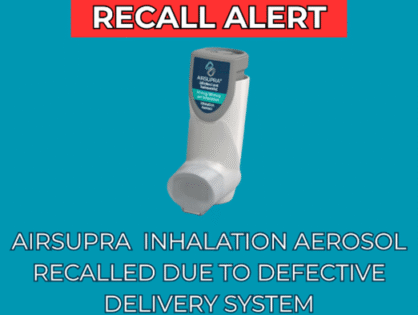
AstraZeneca Pharmaceuticals LP, the maker of the inhalation medication AIRSUPRA® (albuterol and budesonide) aerosol, has initiated a voluntary recall for their product. This recall is effective immediately and involves multiple product lots. The recalled inhalers might not work properly.

Reason for Recall:

A defect in the delivery system of these inhalers has been identified, which may hinder the proper administration of the medication needed for effective asthma control.

Product Details:

Product Name: AIRSUPRA (albuterol and budesonide) inhalation aerosol 

Strength: 90 mcg/80 mcg per inhalation 

Packaging Types:

120-inhalation canister (NDC 0310-9080-12) 

 28-inhalation canister (NDC 0310-9080-28) 

Recall Number:  D-0444-2025 

Affected Lot Numbers:

For 120-inhalation canisters: Lots: 6270044C00, 6270040D00, 6270034E00, Exp Date 10/2026; 6270053C00, 6270045C00, 6270047C00, 6270056C00, 6270052C00, 6270063E00 Exp 11/30/2026; 6270064C00, 6270071D00, 6270075D00, 6270075F00 Exp Date 12/31/2026; 6270107C00, Exp Date 9/30/2027  

For 28-inhalation canisters: Lot 6270019E00, Exp Date 7/31/2025; 6270021D00, Exp 8/31/2025; 6270095C00, Exp 2/28/2026

Rx only, Manufactured for: AstraZeneca Pharmaceuticals LP, Wilmington, DE 19850, By: AstraZeneca Dunkerque Production (AZDP), Dunkerque, France, Product of France

What You Should Do:

Patients and users are advised not to use the inhalers associated with the affected lots. Please contact your pharmacy or healthcare provider as soon as possible to discuss alternative treatment options. Contact the dispensing pharmacy or AstraZeneca for return processing information.

If you are a current patient of the Oklahoma Allergy and Asthma Clinic affected by this recall, please give us a call at 405-235-0040.  

Recall Contact Information:

For product questions, to report an adverse event or side effect, or to report a product quality issue, you can contact the AstraZeneca Information Center by phone at:

1-800-236-9933 (M-F, 8AM-6PM ET, excluding holidays)

Or you can report a product quality issue online: https://contactazmedical.astrazeneca.com/content/astrazeneca-champion/global/en/amp-form.html

For more information on this recall, please visit: https://www.accessdata.fda.gov/scripts/ires/?Event=96857

The post Important Recall Notice for AIRSUPRA Inhalation Aerosol appeared first on Oklahoma Allergy and Asthma Clinic.

Previous Article Needle-Free Option for Severe Allergic Reactions Expanded for Use in Children
Next Article Main Clinic Update
Print
68
Terms Of UsePrivacy StatementCopyright 2026 by Oklahoma Allergy and Asthma Clinic
Back To Top